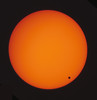
Mission Debriefing
(As you can tell from my photo, I'm kinda big on the transit of Venus.
I've been planning this one for months; back in April, I used the
upcoming transit as my excuse to FINALLY buy a serious digital camera,
one that I can use on my telescope. )
Here's my report on how the day went
TRIP REPORT, TRANSIT OF VENUS 2012 (June 5, 2012)
I've been planning this one for months; back in April, I used the
upcoming transit as my excuse to FINALLY buy a serious digital camera,
one that I can use on my telescope. )
Here's my report on how the day went
TRIP REPORT, TRANSIT OF VENUS 2012 (June 5, 2012)
Thursday May 31st was clear and dry, a beautiful day.
But the forecasts for June 5th were calling for clouds.
But the forecasts for June 5th were calling for clouds.
Over the weekend, I started checking regional forecasts:
the nearest clear skies were west of Toledo.
the nearest clear skies were west of Toledo.
I got up Tuesday, and the local forecast had actually deteriorated,
down to “cloudy with 50% chance of rain”.
down to “cloudy with 50% chance of rain”.
At noon I was charging up the V1 and was dispiritedly planning
to go down to my local astronomy club's viewing at the
Schenectady Museum and stand around with them,
and hope for a break in the clouds.
to go down to my local astronomy club's viewing at the
Schenectady Museum and stand around with them,
and hope for a break in the clouds.
But then I was watching the local weather channels - and noticed
that there were clear skies up on the St. Lawrence: a band of
dry air was pushing up the St. L valley, including the south side
of Lake Ontario. Malone, Watertown are hopeless to get to;
Plattsburgh was clear at noon, but looked like it would be first to
cloud up again.
that there were clear skies up on the St. Lawrence: a band of
dry air was pushing up the St. L valley, including the south side
of Lake Ontario. Malone, Watertown are hopeless to get to;
Plattsburgh was clear at noon, but looked like it would be first to
cloud up again.
But the noon forecast for Tuesday afternoon in Oswego was now “Sunny”.
Now, I’ve left the house and been on the State Fairgrounds
in Syracuse in under 2 hours:
Oswego can’t be 3 hours away: I can DO this.
Or, more precisely: I HAVE to do this.
in Syracuse in under 2 hours:
Oswego can’t be 3 hours away: I can DO this.
Or, more precisely: I HAVE to do this.
(By 2pm, the local forecast had actually improved,
to “Mostly cloudy, 20% chance of rain”,
but, hell: that still didn’t compete with “Sunny”.)
to “Mostly cloudy, 20% chance of rain”,
but, hell: that still didn’t compete with “Sunny”.)
I threw my gear in the car: wheels up at 2:05pm.
(I used the new Civic because I had more gear than
would fit in the Red Menace; AND because I
wanted to be reasonably certain that I'd get there.)
(I used the new Civic because I had more gear than
would fit in the Red Menace; AND because I
wanted to be reasonably certain that I'd get there.)
[Gear:
Bogen tripod;
Gitzo tripod;
Gitzo tripod;
V1 bag with camera and “F-mount-to-Nikon-One” adapter,
Nikkor 300/4.5, TC-300 doubler.
ETX telescope box with various solar filters.
ETX telescope box with various solar filters.
Pelican case with F90s and AF lenses;
Second Pelican case with my surviving F3s.
Film].
(In my rush out the door I clean forgot spare Double-A batteries.
Because over the weekend, I had lost hope, and didn’t rehearse.)
Because over the weekend, I had lost hope, and didn’t rehearse.)
Note that I never did figure out how to run the intervalometer
on the fancy new MF-26 control back on the N90s.
on the fancy new MF-26 control back on the N90s.
Life Lessons:
Rehearse anyway.
Because: Things can change.
Know your gear.
DRILL.
Which also means:
Don’t use new gear on a once-in-a-lifetime shot.
And: Have redundancy: have lots of back-ups.
Off the Thruway ($3.90) at I-481 at 4:00pm; into town, through
the SUNY campus, looking for a view of the NW horizon.
NOT A CLOUD IN THE SKY. Ah, here we go:
the SUNY campus, looking for a view of the NW horizon.
NOT A CLOUD IN THE SKY. Ah, here we go:
Bev's Dairy Treat:
43 County Route 89,
Oswego, NY 13126
(315) 343-0839.
43 County Route 89,
Oswego, NY 13126
(315) 343-0839.
Two miles from Ground Zero (Bridge St., Oswego), right on the lake,
just west of the college campus.*
A beautiful spot, actually.
4:40pm, just about 160 miles out. Plenty of time to spare.
just west of the college campus.*
A beautiful spot, actually.
4:40pm, just about 160 miles out. Plenty of time to spare.
I asked if they minded if I set up in their parking lot - they were fine.
At 4:45, the place was empty.
At 4:45, the place was empty.
(...But at 6 o’clock sharp, every parent in Oswego
brought their toddler out for soft-serve....)
In the course of the evening, I chatted with a few soft-serve
consumers; one told me that there WAS a viewing up on campus.
But I had lacked enough spare time to find them.)
brought their toddler out for soft-serve....)
In the course of the evening, I chatted with a few soft-serve
consumers; one told me that there WAS a viewing up on campus.
But I had lacked enough spare time to find them.)
Observed weather, copied here for posterity:
Albany June 05, 2012
19:51 N 3 10.00 Mostly Cloudy FEW040 SCT080 BKN090 62 49 65 61 62% 29.92 1013.1
18:51 Calm 10.00 Mostly Cloudy FEW030 BKN080 BKN100 62 49 62% 29.91 1012.8
17:51 NE 6 10.00 Mostly Cloudy FEW030 BKN080 63 49 60% 29.89 1012.3
16:51 NE 9 10.00 Mostly Cloudy FEW030 SCT050 BKN080 63 48 58% 29.90 1012.6
15:51 N 7 10.00 Mostly Cloudy FEW020 SCT035 BKN065 62 49 62% 29.91 1012.8
Oswego June 05, 2012
19:54 NW 10 10.00 Partly Cloudy SCT080 SCT090 60 49 70 60 67% 29.93 1013.3
18:54 NW 10 10.00 Fair CLR 63 50 63% 29.91 1013.0
17:54 NW 13 10.00 Fair CLR 66 49 54% 29.91 1012.8
16:54 N 14 G 17 10.00 Partly Cloudy SCT080 69 48 47% 29.91 1012.8
15:54 N 12 10.00 Mostly Cloudy BKN070 68 49 51% 29.92 1013.3
(The north view from the lakeshore was even clearer than
the reported conditions back at the local reporting station:
from 16:40 until long past 19:54, the lakeview sky was still “Fair” for me.)
the reported conditions back at the local reporting station:
from 16:40 until long past 19:54, the lakeview sky was still “Fair” for me.)
I had made the correct decision.
(Yay, me. Yay, satellite real-time views of cloud cover.)
I was set up and ready to go shortly after 5:00pm.
I sat down with the manual and tried to figure out the
multi-function back I had bought for the N90 -
but it was new enough that I hadn't even confirmed that it
was light-tight.
In theory, I could have set it up to start at 6:03:30
and take a frame every :30 or :40 seconds,
right through second contact.
In practice, I wasn't even sure that I could keep
the ETX on target for that long.
So I decided to skip film photography.
.
6:03:53: the Transit of Venus begins,
the last until the year 2117.

I watched from the start until about 8:30, which was
(effectively) local sunset (a cloud bank on the far shore
the last until the year 2117.

I watched from the start until about 8:30, which was
(effectively) local sunset (a cloud bank on the far shore
cut the show short by 10 minutes or so).
I saw it, but was under-rehearsed with my gear.
so I didn’t manage to get a good time for the entry,
(as I was on the smaller lens), and I didn’t see it for
10 seconds or more after the predicted times.
(as I was on the smaller lens), and I didn’t see it for
10 seconds or more after the predicted times.
We learn:
timing the entry is somewhat harder than
timing the exit (which is what I had seen in 2004).
timing the entry is somewhat harder than
timing the exit (which is what I had seen in 2004).
The V1 kept losing focus, and kept reverting to high ISO settings.
The ETX gave a lovely view - distinctly better seeing than I had
for the 2004 event, much better transparency - but I had trouble
setting up cameras on the back port, and was too busy watching /
using the V1 to futz with it much..
for the 2004 event, much better transparency - but I had trouble
setting up cameras on the back port, and was too busy watching /
using the V1 to futz with it much..
Still, I got some movies, and close to 250 digital pictures.
(Then again, giving up on the film cameras
saved me $20-$40 on processing.)
saved me $20-$40 on processing.)
I looked at but neglected to make a note of my GPS position -
but that must be recorded in the EXIF data (or, hell, I could even
go back out sometime and recover it if I had to.)
but that must be recorded in the EXIF data (or, hell, I could even
go back out sometime and recover it if I had to.)
To a few decimal places, I was near 43.451N, -76.556W, and say 280'


U.S. Naval Observatory Astronomical Applications Department
Oswego, NY, (long. W76.5, lat. N43.5):
        Tuesday 5 June 2012   Eastern Daylight Time

                         SUN
        Begin civil twilight       4:51 a.m.
        Sunrise                    5:26 a.m.
        Sun transit                1:05 p.m.
        Sunset                     8:43 p.m.
        End civil twilight         9:19 p.m.
(Oswego - being further west - has sunset 12 minutes later than at home:
I lost the sun behind the clouds at just about my home sunset time.)
All told, I was surprisingly casual about
a once-in-a-lifetime viewing opportunity:
I lost the sun behind the clouds at just about my home sunset time.)
All told, I was surprisingly casual about
a once-in-a-lifetime viewing opportunity:
I saw it, I got some images.
I never even bothered setting up the V1 on the ETX.
I never even bothered setting up the V1 on the ETX.
What I DID remember to do was to switch the ETX to
high-powered eyepieces.
It was one of the most beautiful things I've ever seen.
I decided to spend more of my limited time watching
and less time fighting with photo gear. Very few people have
ever had a chance to see the Dark Side of Venus.
(My other regret is that my family was otherwise engaged and
couldn't be pulled out of their various commitments to come with me.
And having TWO scopes set up was decidedly overly-ambitious
without someone along to assist. My girls - back home
under the clouds, but using the solar glasses - think they saw it
for a few minutes through breaks in the clouds.)

About 8:30, the sun set into a cloud bank on the
far shore of Lake Ontario. This was only about ten minutes
before the theoretical local sunset. (This was less than four hours
after my arrival on-station.)
far shore of Lake Ontario. This was only about ten minutes
before the theoretical local sunset. (This was less than four hours
after my arrival on-station.)
Gear packed back in the car - I struck the ETX first
as viewing deteriorated - the first order of business now
was to hunt for gas, as I had sailed into Oswego
with only about 12 miles showing on the range meter,
too nerve-wrackingly low to go back to the cheaper gas
I had seen on Rt 481 ten miles back in Fulton.
as viewing deteriorated - the first order of business now
was to hunt for gas, as I had sailed into Oswego
with only about 12 miles showing on the range meter,
too nerve-wrackingly low to go back to the cheaper gas
I had seen on Rt 481 ten miles back in Fulton.
(And it’s now night-time: lots of stations will close soon.)
Out Route 104 West a couple of miles? No gas.
Rt. 104 East? No.
Rt.-481South a mile? Yes.
Buy enough gas to get home:
at 9:02pm $20.00 @ 375.9 = 5.320g, at 168.8m trip
at 9:02pm $20.00 @ 375.9 = 5.320g, at 168.8m trip
Back a mile into town for dinner at the Oswego Friendly’s:
(the usual, $9.04 senior (vs $12.74) + a $2 tip)
(This was much easier than finding/trying an alternative.
“Friendly’s” was the best/most obvious choice I had seen coming in.
AND they were open until midnight. Too bad they’re always so slow.
No receipt, either.)
“Friendly’s” was the best/most obvious choice I had seen coming in.
AND they were open until midnight. Too bad they’re always so slow.
No receipt, either.)
Wheels up Oswego ~10:05pm.
(I checked out the 24hr TIM HORTON’S (!) - who knew they
were now on the American side of the lake? - on 481-South,
but they didn’t have anything good left at 10pm.)
were now on the American side of the lake? - on 481-South,
but they didn’t have anything good left at 10pm.)
Off the Thruway at Utica ($2.10) at 11:41pm,
home via the old same route. (5S / 162 / 20)
home via the old same route. (5S / 162 / 20)
Home: ~1:10am, 330.3 miles round trip, with
41.0 mpg showing on the trip meter.
41.0 mpg showing on the trip meter.
(...'Lightfoot Bob', they called him....)
The return leg was 161.5 miles:
therefore, probably about eight miles knocking around Oswego.
The return leg was 161.5 miles:
therefore, probably about eight miles knocking around Oswego.
So: just over eleven hours round-trip. About 3 1/2 hours of
standing on the shore of Lake Ontario.
standing on the shore of Lake Ontario.
(“Back at the lodge, we toasted our adventure....”)
This trip cost $6.00 in tolls, $11.04 dinner,
a theoretical 8.06g of gas (call it about $30);
plus 330 miles of wear on the car.
(On the other hand, I didn’t commute into work Tuesday
(saving at least 31m on the car); just going to the local viewing
would have been 18 miles or so. The cost of the meal is also
negligible: I had to eat anyway - and I had to see the transit.)
All-in-all, this was much cheaper and easier than
flying to Hawaii to see the entirety of the transit.
flying to Hawaii to see the entirety of the transit.
(You’re welcome, Mr. Halley.)
*Fun Facts about SUNY Oswego:
Al Roker B.A. Communications 1976.
Jerry Seinfeld attended but dropped out:
(Queens College CUNY, B.A. in communications and theater, 1976.)
(Queens College CUNY, B.A. in communications and theater, 1976.)
Labels: astronomy, cars, gadgets, hardware, new Civic, Photography, Science, Travel, V1
posted by "As You Know" Bob @ 12:29 AM
0 comments